


Boundary Waters Canoe Area (BWCA) and Quetico Home PageBoundary Waters outfitters provides gear, permits, and guides.Boundary Waters - BWCA - Lodging, Resorts, B&BsBoundary Waters (BWCA) entry pointsBoundary Waters MapsBWCA and Quetico Park Books and MagazinesContact www.BWCA.com


The Wabakimi Project - The Ultimate Portage Clearing Trip!
by OneMatch

Trip Type: Paddling Canoe
Entry Date: 08/07/2010
Entry Point: Other
Exit Point: Other  
Number of Days: 7
Group Size: 4
Trip Introduction:
Prologue This trip, for me, started in March of 2009. I had been discussing with some fellow paddlers about going to Wabakimi for the ultimate remote paddling experience. When I saw the Wabakimi Project had scheduled a presentation, I decided to go check it out. I listened to Phil Cotton's description of the history and objectives of the project. In 2002, Phil took a fly-in/fly-out trip into the northwest section of the park only to find that information, maps and portage trails were scattered at best. Most of the maps were dated back to the 1940s & '50s and they were sectioned with portage trail information that was grossly inaccurate. If he found a trail, the blow down and overgrowth made them completely impassable. It was on that trip that the "Project" became an idea. The next year after posting his thoughts on the Canadian Canoe Routes forum he already had 76 volunteers to help him begin his quest to make Wabakimi more paddler friendly. He has been doing this every year since beginning every Memorial Day and ending after every Labor Day. For the most part a crew changes hands every week (3 in, 3 out  Phil stays in). He takes a two week hiatus last week of June, but logging in about 16 weeks in the park every paddling season. More information on the project can be found on their website at http://www.wabakimi.org/ . I was sold on participating when I not only witnessed Phil's passion for preserving the paddling culture of the area, but when he was adamant about the project finding and clearing ONLY existing portage trails and campsites and correcting their positions using GPS waypoints, measurements and eventually making them available to paddlers in map form. By the end of this season, Phil expects to have 70% o the park completed. The idea of exploring areas and finding old portage trails and campsites left by the trappers and natives of the area excited me, so I signed up for the summer of 2010 (2009 was already filled). I decided to go on the week of Aug 7-14 because it fell in place with my birthday (8/12) and the opportunity to see the Perseid meteor showers in a sky with no light pollution added to the appeal. Looking back now, I was not disappointed. The trip was one of a lifetime for me. I am now known as volunteer #117. I plan to section this report into a description of the methods of how the Project set out to obtain its objectives, a description of our little work week as well as the remote scenery of the area. There are lots of pictures. Thanks for coming along  here we go.
Part 1 of 6


A Well Oiled Machine

First, some bits of information about Wabakimi Provincial Park. It is over 4 million acres in size. That is twice the size of the BWCAW and Quetico combined. The park employs only 2 portage maintenance crews (2 men on each crew) to clear these trails. Considering the fact that we're not sure where most of those trails are, that is a daunting task for 4 men to accomplish. Wabakimi has no management plan in place (there is one scheduled to be publicized by September 2012). As a result, there are no can, bottle, motor or any other restrictions in place. There are many "fishing outpost" cabins spread throughout the park that outfitters have built for fisherman getaways and such, but no one person knows where they all are. In fact, our fly out pilot wasn’t aware of the one on the lake we took out on.

When Phil first started the project 7 years ago he had the blessings of the existing park superintendent. The new superintendent and Phil have not seen eye to eye, however, and this relationship has been the subject of some controversy. But I digress.

Phil Cotton has an amazing and efficient system for meeting his goals. He begins every season with his first crew (a crew of four - he and 3 others) taking the train (with gear and canoes in a special boxcar) out of Armstrong to Savant Lake and working his way to the first area that needs investigation. Every Wednesday of every week, Phil gets on his satellite phone (Iridium - very reliable, I found) and calls into his daughter and next door neighbor in Thunder Bay for a list of needed supplies to cover the next week. On Friday he first calls the float plane staff (Mattice Lake Outfitters) to find out their schedule for the next day and to also inform them of his location. He then calls Thunder Bay at 5:30pm to check to see if the new crew has arrived, tell them their flight departure time and any last minute details that may need to be covered. The new crew gets an orientation in Thunder Bay and loads up. Saturday they drive to the float plane dock (3 hrs from Thunder Bay), load their gear and supplies in the plane and take off to Phil’s location. When they land, they get off, the old crew gets in and a new week with a new crew is under way. It all seems to go very smoothly.

With that info in mind, me and a delightful couple from Strathroy, Ontario - Tetcy ( a Dutch name) and Ray - met for our orientation in Thunder Bay, had a get acquainted dinner there and took off for Wabakimi the next morning.

Here we are loading our float plane (a De Haviland Beaver) at the outfitters:
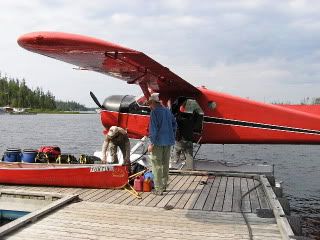


Tetcy and Ray had the back two seats, I sat next to the pilot:
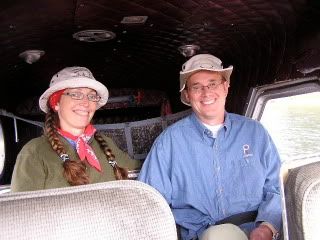
Photobucket

We take off promptly and see Wabakimi first from the air:
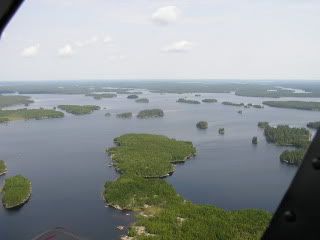
Photobucket

about 20 minutes later we land (very smoothly!) on Elf Lake – in the center of the park - and Phil and crew were paddling up to us before you know it:
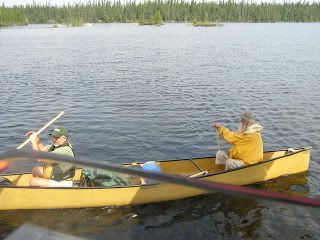
Photobucket

Phil gives us another orientation – how the Sat phone works (I got to call my wife - got a voicemail!), camp layout and such.

Here are some pics from our first site on Elf Lake:
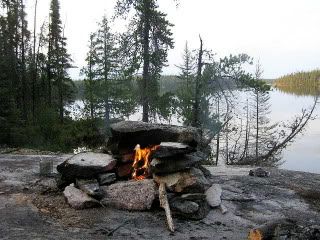
Photobucket

Photobucket

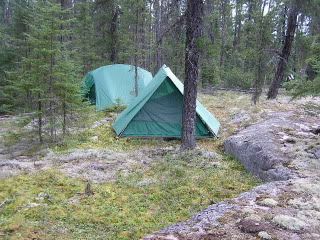
Our tents were Eureka! 4 person tents so there was lots of space. Tetcy and Ray, of course had a tent and I shared with Phil:
Photobucket

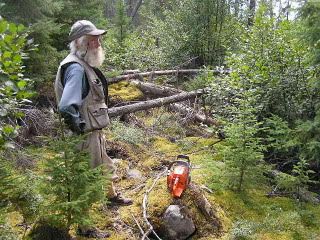
After a short lunch, Phil wasted no time putting us to work. A nearby trail had some blow down that needed clearing, so off we went:

The trail before cleaing:
Photobucket

and after clearing:

Photobucket

We then headed back to camp for dinner, libations and set the plan for the next day. It seems there was a 650 meter trail that the previous crew had found and flagged and it was very much over blown with trees and shrubs and virtually impassable. Our job was to clear it and measure it.

Part 2 of 6


How To Find, Flag, Clear and Measure a Wabakimi Portage Trail

The way Phil organizes the portage clearing side of things is, once again, a picture of efficiency.

Phil begins each morning pouring over maps to determine the days operations:

Photobucket

After his morning coffee and contemplation, he shows us what we’re in for:

Photobucket

The task is first to find (using the old maps - in one case, Phil was using a map from the 1750s) the old trails by diligently looking for old blazes made on the jackpine by the trappers and such. These blazes could be as old as 300 years. Here is an example of one:

Photobucket

They were usually made with 2 down strokes of a hatchet and then one or 2 upstrokes. Sometimes they were easy to find, other times it was very difficult. Some trees with blazes were blown down and created a challenge for us as well.

Once the blazes were found, a temporary "flag" of plastic tape around that tree and then the crew looked for the next blaze:

Photobucket

Once the entire trail was flagged (usually an all day operation), then it was time to clear it.

Here is another section of blowdown before the clearing:

Photobucket

and then after:

Photobucket

This is done section by section and we gradually work our way to the other end. Each entry and take- out point as well as each blaze is way pointed on the GPS. We then take a metric tape measure and walk back adding up the meters as we go:

Photobucket

Photobucket

It turns out this trail was 645 meters long. It took us all day to get it cleared and measured. We were one tired crew at the end of the day and were ready for a nice meal, libations and some rest.

Part 3 of 6


Campsite Inventory:

The next day we left Elf to make our way across some (now-cleared) trails and lakes to Granite Lake where we would visit Granite Falls (pictures later) and look for potential campsites along the way. Each site was explored and if determined to be "campable", it was waypointed on the GPS. No campsites were cleared or prepared unless we were camping there ourselves. Here is one old fire ring we found along the way:

Photobucket

and another: Photobucket

Who knows how long it had been since another human here looked out over a crackling fire onto a beautiful lake?

We found this old hatchet scarred log on another site:

Photobucket

Here is our 2nd site (one night only) on upper Granite Lake:

Photobucket

I found this rock with a ring of crystal in its center at the site to be very interesting. I dubbed it the "Saturn Rock".

Photobucket

Photobucket

Here is another view from our 2nd campsite:

Photobucket

So we mostly paddled and inventoried campsites with a stop at the falls. It was a welcome day of leisure compared to the clearing the day before.

And as you will see in the next section, it wasn’t all work and no play.

Part 4 of 6


Wabakimi Scenery

Phil wants to make sure his crews enjoy the magic that is Wabakimi and he sets time aside for every crew to have some leisure time and enjoy the scenery. Here are some pics from those times – and they were many.

As stated earlier, we visited Granite Falls which is in two sections. Here is Upper Granite Falls:

Photobucket

And lower Granite Falls

Photobucket

We also visited Brennan Falls on our way to our third (and final campsite) on the south end of Granite Lake:

Photobucket

Blueberries were very, very abundant:

Photobucket

and we made good use of them:

Photobucket

botanically we found a lot of "British Soldiers":

Photobucket

Pixie cups:

Photobucket

Pitcher plants in the bogs (I call them “lumps and clumps) Photobucket

AND much to my delight we found sundews:

Photobucket

I had never seen them before in the wild (thought they were Venus fly-traps at first)!

A partridge was entertaining us on one trail:

Photobucket

as well as this old 25 gallon fuel drum. It had a 1964 date on it:

Photobucket

This survey marker by Granite Falls was dated 1925:

Photobucket

I took this crescent moon sunset pic on my birthday. What a great present!

Photobucket

Part 5 of 6


Saying Goodbye:

We base camped on the South end of Granite for 4 days, flagging and measuring a 1700 meter trail (needed so little clearing, we let it go. Phil doesn’t want to cut everything around, keeping in mind many paddlers would want it that way), searching out and finding blazes (and flagging) 2 200 meter trails into the next lake - Otter Bluff.

Saturday morning came sooner than we thought it would. We posed for our final crew picture: Photobucket

We then paddled out to wait for our float plane to arrive. We soon heared the Beaver’s drone and saw it coming:

Photobucket

It landed soon after and we paddled out to it. The new crew got off:

Photobucket

and paddled away as we waved goodbye:

Photobucket

As in our first look at Wabakimi, our last look was also from the air:

Photobucket

We arrived shortly back at Mattice Lake Outfitters, went into Armstrong for some Snickers bars and "pop" and headed back into Thunder Bay. There I said goodbye to my new friends and headed back to Grand Marais for yet another adventure.

Part 6 of 6


Short Conclusion

By week’s end, our schedule wound up as: Saturday, Day 1 - fly in to Elf Lake Campsite, lunch and an afternoon clearing Sunday, Day 2 - Clear and measure a previously flagged trail Monday, Day 3 - Paddle to Granite Falls doing small clearing work and         Campsite Inventory on the way. Camp on the northeast         Side of Grantie Lake Tuesday, Day 4 - Campsite Inventory of the east side of Granite Lake while on the way         To set up new camp on the south end of the lake. (We also found          -and waypointed-two fishing posts) Wednesday, Day 5 – Rainbound in camp. When the rain cleared in late afternoon, Ray          And I paddled to investigate some cliffs and look for the blazes for          A trail (we found it). Thursday, Day 6 - Walk, flag, waypoint and measure a 1700 meter portage trail. Friday, Day 7 - Search and flag two 200 meter trails Saturday – Exchange crews and fly out.

There is some controversy surrounding Phil and the Wabakimi Project. I can understand that considering his "full speed ahead" mission and the new superintendent's idea of what to accomplish there. However, after this experience I totally support what Phil is doing. I wouldn’t even think of paddling Wabakimi without having the information that he has meticulously accumulated the last 7 years and has done so without any profit and at times with some measurable hardships.

I am proud to be Volunteer # 117 and I foresee a day when someone will ask me what it was like to paddle with Phil Cotton.

Thanks for coming along. I have lots of other tidbits, stories and information about this trip and welcome your comments and questions!

Jerry


    Back to Trip Report Main Menu


Copyright © 2002 - 2010 www.bwca.com - Legal Notice