

The Next Level-South Arm of Knife Base Camp
by YardstickAngler
Trip Type:
Paddling Canoe
Entry Date:
06/14/2026
Entry & Exit Point:
Saganaga Lake Only (EP 55A)
Number of Days:
10
Group Size:
2
Trip Introduction:
This is the account of my fifth trip to the Boundary Waters, and my son Andrew’s second. This was a fishing-centric trip to the South Arm of Knife, an area I’ve always wanted to visit.
I heard recently that a writer’s job is to make a coherent whole out of seemingly disparate, random events. While I’m not a writer, I attempt to do that here. It doesn’t make for a short report. But if you read on, you’ll gain insights not only into what we did and where we went, but how we felt in the moment. I hope you enjoy it.
Discuss Trip:
View Discussion Thread (4 messages)
Part 1 of 16
Prologue: Background, Dreaming, and Preparation
Before we had even reached Grand Marais, the maps were out. It was June 14th, 2025. Andrew and I had just completed his first trip to the Boundary Waters, a base camping trip on Grandpa Lake that featured near-constant fishing action for Northern Pike and Smallmouth Bass, campfire sessions that continued late into the evening, and some very agreeable weather. To be clear, we also battled hordes of mosquitoes in our campsite which backed up to a bog, and most days included at least one long, rugged portage. But for us, the challenges paled in comparison to the many high points we experienced on that trip. And so, surrounded in our tiny car by our gear still smelling strongly of campfire smoke, with a 15 hour drive ahead of us that would return us to our normal lives for another 365 days, we began to dream.
Our second trip, like the first, would focus on fishing. With that first trip behind us, we sought out a route that would provide plenty of good fishing with slightly more travel than our first trip had. Now that we had gained some confidence in our fishing setup and abilities, we also wanted to try our luck fishing on some lakes that had some larger fish in them.
On my first ever trip to the Boundary Waters, my paddling partner Shawn and I had planned a loop through the South Arm of Knife Lake, but cut our trip short, base camping on Ester Lake with day trips to fish on nearby Ashdick and Rabbit lakes. While I was disappointed in not reaching South Arm, I gained a great appreciation for the Ester Lake area and vowed to return someday.
Now, staring at the map, all of these factors kept pointing toward the South Arm of Knife once again, a lake I’d heard so many good things about but had never been able to visit. Could this be the year? I realized that an entry on Saganaga would allow for a camp in the Ester Lake area for some fishing before pushing on to the South Arm. We would plan to exit the same way rather than complete a full loop through Seagull, which would allow for more fishing time in an area I was more familiar with if the fishing on the South Arm didn’t meet our expectations. The more we looked at this route, the more options we saw, especially when considering the options available for fishing to the north on Knife Lake, as well as nearby smaller lakes such as Toe, Bonnie, Dix, and Spoon. Considering my affinity for the Ester Lake area, the entry point that made the most sense to me was Saganaga, where I have entered twice before, including last year’s trip with Andrew. There is just something about Saganaga that always draws me back, something that I don’t sense on nearby Sea Gull Lake. It’s a place where you can just breathe in and sense the human history that has occurred there for centuries. When Sag isn’t challenging you with navigating through it’s many large islands, it will suddenly whip up into whitecaps and rollers that will keep you on your toes. But in the moments when your navigation is on point and the weather is amiable, Saganaga is immensely beautiful and enchanting. When deciding whether we should tow across Saganaga or paddle, I favored paddling for the adventure, experience, and chance to keep an open schedule, but wanted to make sure Andrew was on board. When I asked him about it, detailing the challenges Sag might offer us, his response was “I think we should paddle it because I’ve never truly paddled all the way across Sag before. The tow would be nice but at the same time, it feels a little bit like I’m cheating myself out of a valuable experience.” He couldn’t have said it better…barring bad weather on entry day, we would be paddling across mighty Sag. While I had some trepidation about this, I was confident in our ability to handle it and loved Andrew’s sense of adventure.
In December, I called Voyageur Canoe Outfitters to make our bunkhouse and permit reservation…Bill from VCO told us we were the first reservation he had taken for the upcoming paddling season!
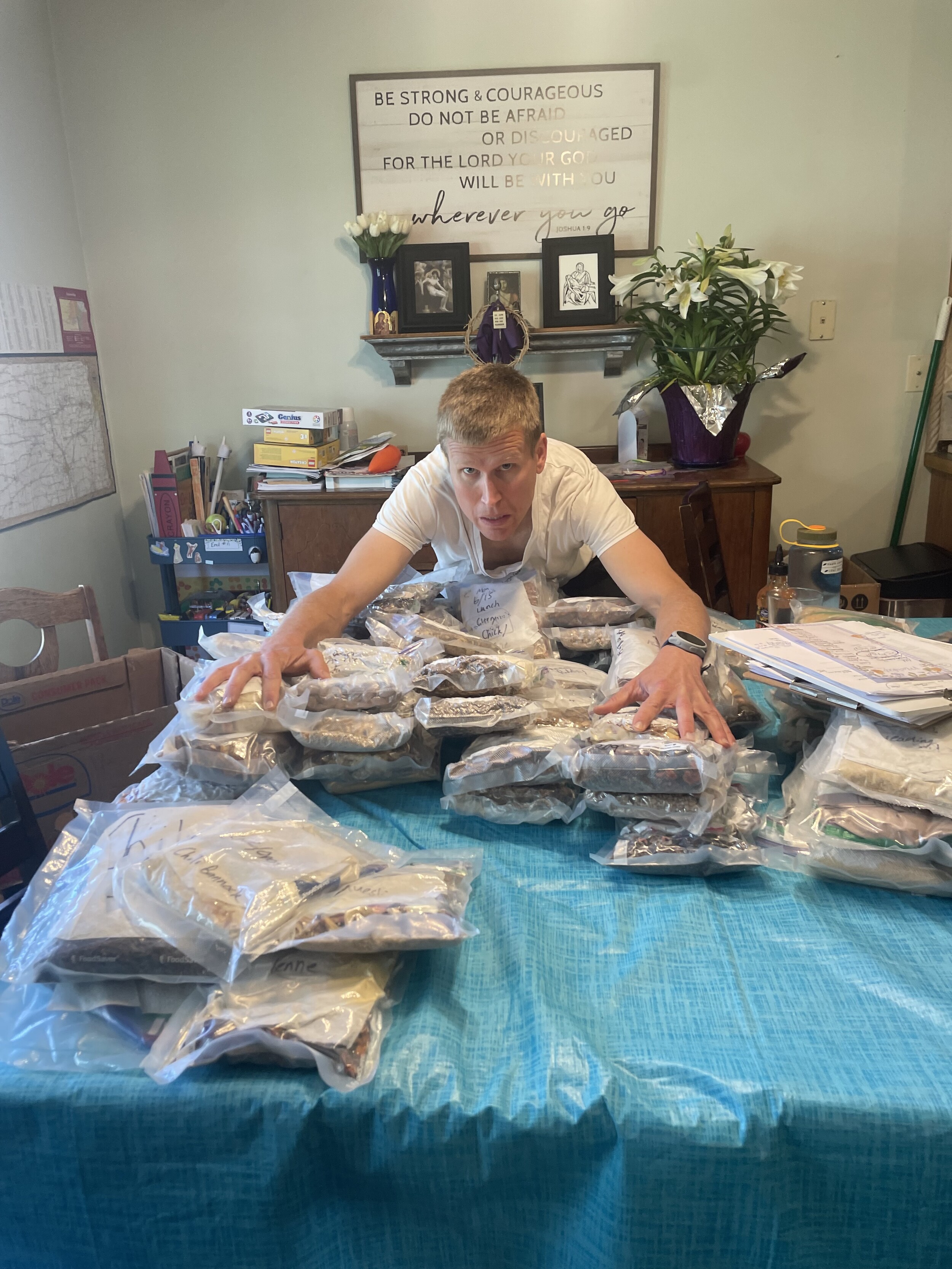
When not brainstorming the route, I filled many days and nights of late summer and fall dehydrating tomatoes from our garden as well as whatever produce was in season from the grocery store. Our trip would be 3-4 days longer than last year to allow plenty of time to slow down and fish without traveling too hard, and at times it felt like prepping the meals for this longer footprint was an insurmountable task. Somehow, by late March, all of the dehydrated meals were sealed and ready, freeing me at last to focus on the other gear required.
New gear was added to the pack for this trip was:
Ursack Major 2XL: A longer trip meant needing more food. So we needed another bear bag.
Pocket Bellows: Added after struggling to start campfires last year with unfavorable winds.
Helinox Table: Our evening meal is a slow paced, leisurely affair in front of the fire, often including 3-4 courses as we reflect on the day and dry out our feet. A table will help keep all the food and cooking gear off of the ground so we aren’t losing it, stooping for it, or tripping over it.
Rod Holders for the Canoe: Replacing holding rods with our legs while trolling.
WarBonnet RidgeRunner Hammock: Replacing my Blackbird hammock. This was for me. As a taller guy, I found it difficult to get comfortable in the Blackbird when not set up perfectly. After trying out Andrew’s RidgeRunner, I knew I needed to invest in one myself.
Tackle: We added over 8 pounds to our tackle for this year’s trip. Given we had never really fished for Lake Trout or Walleye, we needed to add some lures capable of fishing more deeply, including tail dancers, shad dancers, and some deep diving Rapalas. We also added some Z-man swim bait minnows and bolstered our supply of Vibrax spinners, Whopper Ploppers, Little Cleos, and Syclops spoons. While I know we overpacked in terms of tackle, we are still trying to figure out what works best for us in the Boundary Waters, and preferred to keep our options open, even though it meant extra weight and bulk.
Fishing net: Last year, we endured much frustration with hooks tangling in our net, and it was too short for Andrew to be able to turn around from the front seat and help with the few fish I caught. It added another pound or two, but I hoped it would prove worthwhile.
Fun stuff: We added a travel chess board, deck of cards, and hacky sack for slower moments around camp.
I had a twinge of anxiety adding this new gear, but felt strongly that it would all be put to good use. In the past year, Andrew had grown much stronger and would be able to carry more weight on the portages. Would our shoulders be strong enough to bear the burden of more travel and more weight? Soon enough we would know!
Before we had even reached Grand Marais, the maps were out. It was June 14th, 2025. Andrew and I had just completed his first trip to the Boundary Waters, a base camping trip on Grandpa Lake that featured near-constant fishing action for Northern Pike and Smallmouth Bass, campfire sessions that continued late into the evening, and some very agreeable weather. To be clear, we also battled hordes of mosquitoes in our campsite which backed up to a bog, and most days included at least one long, rugged portage. But for us, the challenges paled in comparison to the many high points we experienced on that trip. And so, surrounded in our tiny car by our gear still smelling strongly of campfire smoke, with a 15 hour drive ahead of us that would return us to our normal lives for another 365 days, we began to dream.
Our second trip, like the first, would focus on fishing. With that first trip behind us, we sought out a route that would provide plenty of good fishing with slightly more travel than our first trip had. Now that we had gained some confidence in our fishing setup and abilities, we also wanted to try our luck fishing on some lakes that had some larger fish in them.
On my first ever trip to the Boundary Waters, my paddling partner Shawn and I had planned a loop through the South Arm of Knife Lake, but cut our trip short, base camping on Ester Lake with day trips to fish on nearby Ashdick and Rabbit lakes. While I was disappointed in not reaching South Arm, I gained a great appreciation for the Ester Lake area and vowed to return someday.
Now, staring at the map, all of these factors kept pointing toward the South Arm of Knife once again, a lake I’d heard so many good things about but had never been able to visit. Could this be the year? I realized that an entry on Saganaga would allow for a camp in the Ester Lake area for some fishing before pushing on to the South Arm. We would plan to exit the same way rather than complete a full loop through Seagull, which would allow for more fishing time in an area I was more familiar with if the fishing on the South Arm didn’t meet our expectations. The more we looked at this route, the more options we saw, especially when considering the options available for fishing to the north on Knife Lake, as well as nearby smaller lakes such as Toe, Bonnie, Dix, and Spoon. Considering my affinity for the Ester Lake area, the entry point that made the most sense to me was Saganaga, where I have entered twice before, including last year’s trip with Andrew. There is just something about Saganaga that always draws me back, something that I don’t sense on nearby Sea Gull Lake. It’s a place where you can just breathe in and sense the human history that has occurred there for centuries. When Sag isn’t challenging you with navigating through it’s many large islands, it will suddenly whip up into whitecaps and rollers that will keep you on your toes. But in the moments when your navigation is on point and the weather is amiable, Saganaga is immensely beautiful and enchanting. When deciding whether we should tow across Saganaga or paddle, I favored paddling for the adventure, experience, and chance to keep an open schedule, but wanted to make sure Andrew was on board. When I asked him about it, detailing the challenges Sag might offer us, his response was “I think we should paddle it because I’ve never truly paddled all the way across Sag before. The tow would be nice but at the same time, it feels a little bit like I’m cheating myself out of a valuable experience.” He couldn’t have said it better…barring bad weather on entry day, we would be paddling across mighty Sag. While I had some trepidation about this, I was confident in our ability to handle it and loved Andrew’s sense of adventure.
In December, I called Voyageur Canoe Outfitters to make our bunkhouse and permit reservation…Bill from VCO told us we were the first reservation he had taken for the upcoming paddling season!
When not brainstorming the route, I filled many days and nights of late summer and fall dehydrating tomatoes from our garden as well as whatever produce was in season from the grocery store. Our trip would be 3-4 days longer than last year to allow plenty of time to slow down and fish without traveling too hard, and at times it felt like prepping the meals for this longer footprint was an insurmountable task. Somehow, by late March, all of the dehydrated meals were sealed and ready, freeing me at last to focus on the other gear required.
New gear was added to the pack for this trip was:
Ursack Major 2XL: A longer trip meant needing more food. So we needed another bear bag.
Pocket Bellows: Added after struggling to start campfires last year with unfavorable winds.
Helinox Table: Our evening meal is a slow paced, leisurely affair in front of the fire, often including 3-4 courses as we reflect on the day and dry out our feet. A table will help keep all the food and cooking gear off of the ground so we aren’t losing it, stooping for it, or tripping over it.
Rod Holders for the Canoe: Replacing holding rods with our legs while trolling.
WarBonnet RidgeRunner Hammock: Replacing my Blackbird hammock. This was for me. As a taller guy, I found it difficult to get comfortable in the Blackbird when not set up perfectly. After trying out Andrew’s RidgeRunner, I knew I needed to invest in one myself.
Tackle: We added over 8 pounds to our tackle for this year’s trip. Given we had never really fished for Lake Trout or Walleye, we needed to add some lures capable of fishing more deeply, including tail dancers, shad dancers, and some deep diving Rapalas. We also added some Z-man swim bait minnows and bolstered our supply of Vibrax spinners, Whopper Ploppers, Little Cleos, and Syclops spoons. While I know we overpacked in terms of tackle, we are still trying to figure out what works best for us in the Boundary Waters, and preferred to keep our options open, even though it meant extra weight and bulk.
Fishing net: Last year, we endured much frustration with hooks tangling in our net, and it was too short for Andrew to be able to turn around from the front seat and help with the few fish I caught. It added another pound or two, but I hoped it would prove worthwhile.
Fun stuff: We added a travel chess board, deck of cards, and hacky sack for slower moments around camp.
I had a twinge of anxiety adding this new gear, but felt strongly that it would all be put to good use. In the past year, Andrew had grown much stronger and would be able to carry more weight on the portages. Would our shoulders be strong enough to bear the burden of more travel and more weight? Soon enough we would know!
Weight details: Bear bag weights with all food: 60 pounds | New tackle: Added 8.5 pounds | Rod holders: Added 3.5 pounds | Net: Added 2 pounds | Fun stuff: Added 2 pounds |Helinox table: Added 1.5 pounds | Different hammock: Added 8 ounces
 Donate - BWCA.com
