


The Next Level-South Arm of Knife Base Camp
by YardstickAngler
Monday, June 22nd, 2026
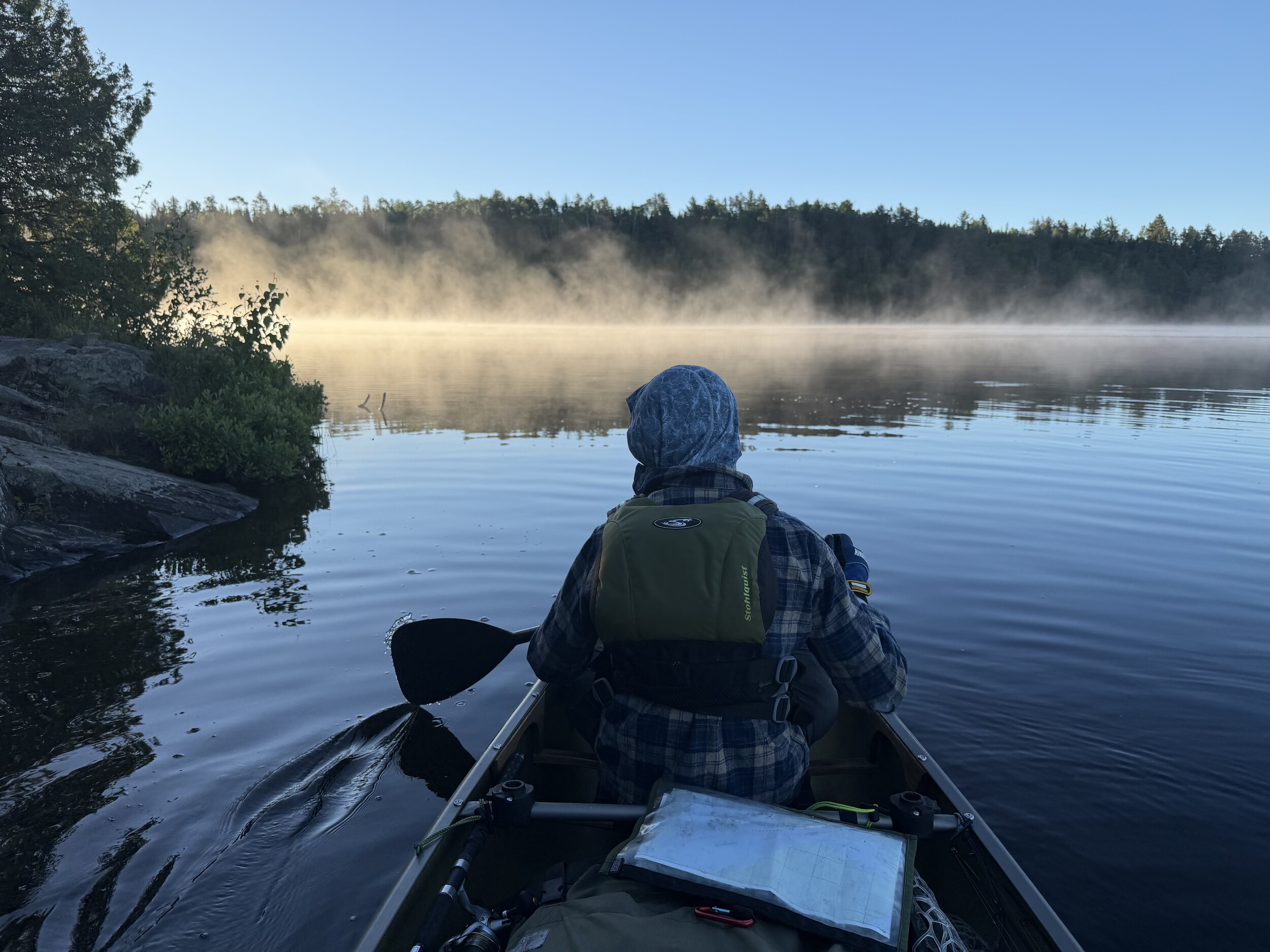
After a 4:15 wake up call, we launch into the mists rising off of Ashdick Lake at four minutes past 6. Within seconds, we reach the landing for the portage into Swamp. When nearing the South Arm, we were beside ourselves with excitement, given the hype that surrounds its beauty and fishing. Somehow, after years of hearing about how awful this portage will be and discussing it for the whole trip, we approach it with the same level of excitement as we did Knife. The wry smirks on our faces are all that betray our knowledge that we might be biting off more than we can chew. We feel nearly the same about paddling across Saganaga today, which gave us so much trouble on the way in, even though the winds are forecast to be calm all day. It’s an attitude of “Let’s take on all the demons the park can throw at us, see how we fare, and we’ll have a tale or two to tell.” At long last, the anticipation is over.
I shoulder the canoe with a grunt and steadily march forward into whatever awaits us, counting steps to pass the time and occupy my mind. If Andrew is within earshot, I quietly say each time we’ve conquered another hundred steps. Especially since we double portage, this also gives me a gauge of how much is left when taking the second load across. All the while, I am taking mental notes on every obstacle of this notorious path so I can pass as much information on to the outfitter and anyone else who wants to know. In spite of all the mosquitoes we’ve dealt with on this trip, it isn’t buggy in the least on this calm morning, which I consider a miracle. Complaints that this is a steep portage are also overblown, with the exception of the steady drop on the Swamp end. All other descriptors of this portage fall squarely under the “type 2 fun” category, however. We lose count of the number of muddy spots (maybe seven in total?) along the way, and at least four of them are prodigious both in their size and depth. On the first pass, I take a misstep on one of the nearly useless logs in the worst mud pit, lose my balance and stumble my way into thigh deep mud and crash down onto my backside. After a moment to chuckle at myself and heave the canoe off my shoulders, Andrew helps pull me out and I continue on my way. The footing is rough, scrambling over angled rocks most of the way (very comparable to the Ester-Ashdick portage) and can only be described as “good” for about ten steps. Right at that point, a large tree has fallen across the path at chest height to make sure you don’t get too comfortable. There are a few other stepovers of logs, and overgrowth accompanies us for the great majority of the portage. This overgrowth is especially thick on the Swamp end. By the end of my first trip with the canoe, I count over 1700 steps, which is a much higher ratio of steps per rod than the Hanson-South Arm portage had been, owing to the bad footing throughout which requires many shorter steps to keep your balance. On the second trip across with the packs, I count nearly 200 fewer steps due to the lightened load. With this long-anticipated portage complete, Andrew and I pause at the Swamp end to rehydrate and bask in the glory of completing the toughest portage of our trip, with only the short liftover into Saganaga remaining. But we are both stunned when our reverie is interrupted by the sound of someone crashing through the overgrowth behind us, a group of nine scouts with a trio of three person canoes! I quip that I thought we were the only ones crazy enough to be out here on this portage at such an early hour, and they simply shrug their shoulders and say they came from Hanson this morning. They are also bound for Saganaga today, and relay that they’ve had a great trip with decent fishing. I am impressed by their gung-ho attitudes and complete lack of complaining, as well as how little they pack, compared to us. Soon they are on their way, and we take our time leaving the landing behind them.
I am dreading the lift over portage into Saganaga after remembering it being so slick and awkward on the paddle in, but we have an easier go of it this time around. No portages left! I want to revisit the first-ever campsite my friend Shawn and I stayed at in the park for our morning breakfast break, so we take a slight detour that way, where we see another large scout troop prepping to leave. We anchor our canoe a fair distance away in a nearby cove and eat breakfast in the canoe once again. Once we are done, the group has vacated the site, so we land for a quick walk down memory lane. The site, #339, is a spacious one in a secluded spot in the far northwest arm of Saganaga, and one I will always remember fondly. Andrew laughs as I recount the story of my first attempted bear hang off of a tree precariously perched atop a high cliff, a cliff I very nearly tumbled down into the lake while attempting said bear hang.
We leave the site at 9:06, and enter the wide open northwest “neck” of Sag at 9:36. This portion of our opening day paddle was perhaps the most mentally challenging, since we were both exhausted from battling the headwinds to get here, then fought over an hour of crosswind rollers down this long, featureless highway of water. Today, with nearly calm winds and barely a ripple on the water, I am confident this will be a much better paddle, perhaps an enjoyable one. From the start of the neck, it’s 20 minutes to “Desolation Island,” the large island in the western end of the neck that looks so close from American Point, yet takes forever to reach. From there, it’s another 40 minutes to American Point. We shoot straight across the wide open portion of Saganaga through Munker Narrows with little trouble, aside from changing our course 1-2 times to make sure we are paddling into the narrows and not one of Munker Island’s large bays. After passing the narrows, we also take multiple compass readings to navigate toward the narrows that pass just south of our targeted island campsite, #366. We reach this site at 12:10, having spent about 2.5 hours paddling most of Saganaga in pristine conditions. With the great majority of Saganaga behind us and our final campsite secured, both Andrew and I are elated. Andrew repeatedly says how he wanted to like paddling on Sag, and today was the day he finally enjoyed it, on his third attempt.
This site is very well-situated for a quick paddle to the exit tomorrow morning, which should prevent me from having to drive deep into the night to get back home. While I have visited this site before (also on my first trip, when Shawn and I stopped here for lunch and I managed to lose then later recover my phone near the latrine), I am surprised at how much I enjoy it, given its location in a relatively well-traveled area of the lake. The “front porch” of the site is a huge, flat grassy area with several large boulders that are perfect for laying wet gear and clothing in the sun to dry. The fire grate is roomy and well-kept, with a nice view. Today is the hottest day of the trip, at 68 degrees, so we take advantage of a shady “upper deck” above the fire grate to relax. While I prefer camping in secluded areas that can be a bit rough around the edges but less-trafficked, I find that I really enjoy sitting up here in this site and watching the world go by on Saganaga. Two motorboats quietly pass by, then a canoe, all of whom share a wave as they pass. After setting up the water filter, hanging hammocks, and gathering firewood, we can’t resist just one more attempt at catching a fish. While I’m readying the canoe, Andrew tosses the Choppo from shore in front of the site and manages to catch a 10” smallmouth. Nothing too special, but it ends up being the only fish caught on topwater for the entire trip. We troll the channel of water in front of the site, and around a nearby island where I nearly caught a decent pike last year, but have no success, so we return to the site for the evening.
We have a little trouble finding “perfect” hammock trees that aren’t perched on top of rocky ground, but it’s not too hard to make it work here, given all the space. With no chance of rain in the forecast, we choose not to stake out our tarps tonight so we can enjoy a wide open view of the sky as we sleep. This will speed tomorrow’s breaking of camp in the pre-dawn hours. There is something about this site that is just perfect for the last night of our trip. I feel completely carefree and comfortable here, on this lake that is a part of so many memories of the Boundary Waters for me. Andrew and I do our best to clean out the food pack, finishing off the hashbrowns and summer sausage, followed by a main course of tomato/sausage garlic couscous and mud pie for dessert (chocolate pudding with nuts and granola). We talk a great deal about what trip we will plan for next year. My next youngest son will be ready for his first trip to the Boundary Waters next year, and I want to make sure he at least gets to take one trip on his own with me, as Andrew has been able to do. I also want to make sure Andrew doesn’t miss out on taking a trip next year, so I resolve that next year I will find a way to make both trips happen. We make tentative plans for a Clearwater loop with Andrew next year, and a basecamp trip with his younger brother, similar to Andrew’s first trip.
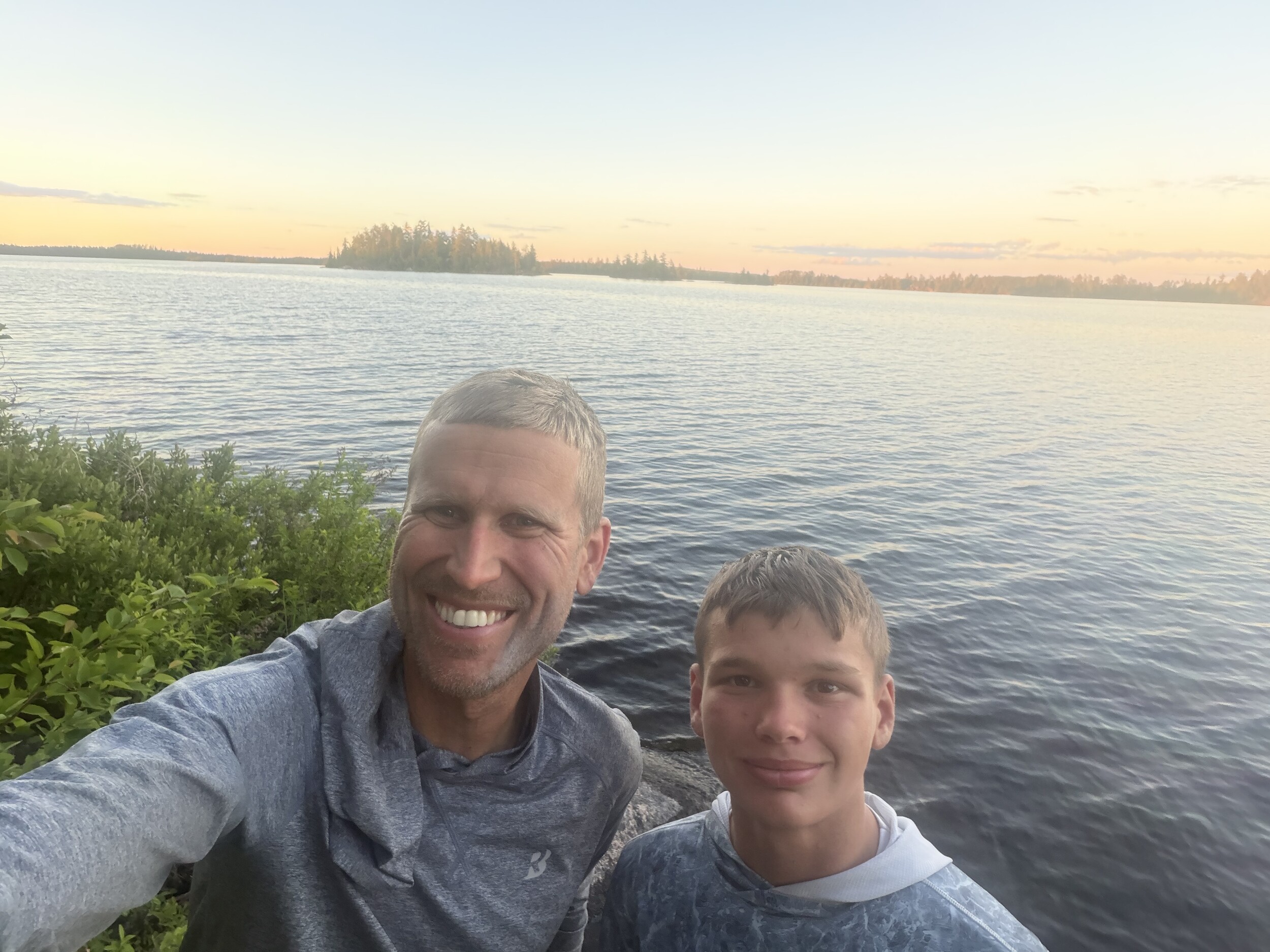
These last two days of travel from the South Arm have been the perfect “slow goodbye” to this wilderness I love so deeply. Sitting by the fire on Saganaga under a fading twilight sky, there isn’t much more to do, and little else to say that hasn’t already been said. We spend a great deal of time discussing and writing down some “nuts and bolts” stats from our trip, detailing which gear we used the most, how much food and fuel we have leftover, and which gear needs to be maintained or replaced before our next trip. Though I take pride in being well-prepared and organized, when it comes to the overall “success” of this trip, the numbers and data are insignificant when compared to matters of the heart. We could have caught more fish, and would have preferred more amicable paddling conditions on our entry day. But at the same time, adversity is a prerequisite for any fulfilling pursuit…I did all I could to prepare an ideal wilderness trip, but when all is said and done, the wilderness itself provides the beauty, adversity, and fulfillment in perfect measure. After ten days, we have both reached stasis, fully content here and somehow fully ready to slowly re-enter our everyday lives.
We douse the fire, do some final organizing, then turn in under twilight skies, with the plan of launching at 4 A.M. tomorrow morning. The long road home awaits.
Stats—> Portages: 2 | Portage rods: 185 | Paddle distance: 6.7 miles | Travel time: 6:00 | Fishing time: 0:45 | Fish caught: 1 (1 SB) | Lakes: Ashdick, Swamp, Saganaga
 Donate - BWCA.com
