


BWCA Entry Point, Route, and Trip Report Blog
October 19 2026
Entry Point 25 - Moose Lake

Number of Permits per Day: 27
Elevation: 1356 feet
Latitude: 47.9877
Longitude: -91.4997
Labor day weekend 2024.
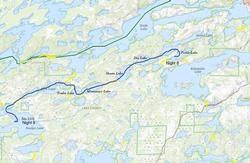
Entry point was 25-Moose lake. Went north, and then west onto Ensign Lake. Camped on eastern end of Ensign lake. Very busy and lucky to get a campsite. Day 2, went to Cattyman Falls and on down to Disappointment Lake. All sites full. Had to get off the water due to inclement storm. Ended up on Parent Lake on day 3, western camp site. Beautiful site. Exited from Snowbank lake on day 4. Overall fishing was poor. Some small mouth bass on Parent lake.
Nothing elsewhere. Approximately 20 miles of paddling/portaging. 11 portages in total. Already planning for 2025.
Our First Real BWCAW Trip
Entry Date:
August 29, 2026
Entry Point:
Moose Lake
Number of Days:
10
Group Size:
2
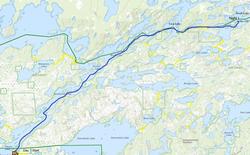
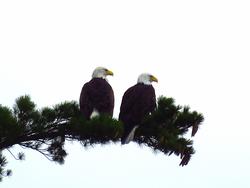
Day 1 started with breakfast at Britton’s, and we uncharacteristically managed not to over-order/over-eat. Walked back to the Canoe On Inn, checked out, and drove to our Moose Lake put-in. Our route was familiar to us from Moose Lake to Carp Lake, as we’d traveled that at the start of last year’s Quetico trip, but after that, almost everything was new to us. We were lucky enough to see several bald eagles, including a pair that posed for us in a tall pine.
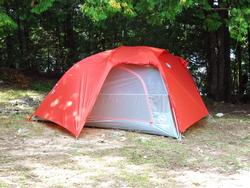
It was suggested that we spend our first night on Birch Lake, but we had lunch there, and didn’t want to stop paddling so early in the day. We pressed on to Knife, and checked out the site (#2187) on the east end of Robbins Island. It was bigger than we needed, but it was around 3 pm when we got there, so we claimed it. No views, but nice and clean. At our lunch stop we had found a fancy clothes line; with camp set up, we soon had wet socks hanging on it. Dinner was a spaghetti experiment which we really liked, but will try to dial its weight down a bit. We really appreciate the USFS grills at each campsite; while we seldom have fires the grill surface works well with our cooking gear. Quetico sites frequently require that we move a flat rock or two to make a cooking area compatible with our setup. During last year's trip we discovered that the Big Agnes Copper Spur UL3 we bought used in 2018 had developed seam tape delamination and leaked during heavy rains, so we we were sporting a new tent this year, a Big Agnes Copper Spur UL3 HV.
After dinner we retired to the tent and reviewed the day's route and looked at options for Day 2. We were getting close to some of the summer’s fire damage, and don’t quite know where travel might be blocked, so looked at a couple route options. After developing a route for Day 2, we read a couple stories from Patrick McManus’ “Real Ponies Don’t Go Oink” and called it a night.
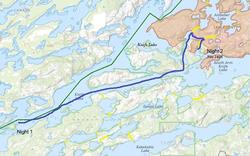
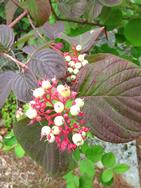
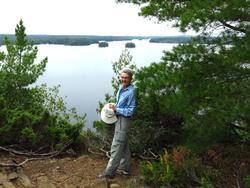
We were really tired after yesterday's 13+ miles, and were asleep by 8:00pm. A midnight nature call revealed a clear sky and moon just past full, but when we got up a bit after 6:00am the sky was gray and the clouds too heavy to see a real sunrise. Had coffee and loaded oatmeal for breakfast, then cleared camp and started paddling. The light breeze we'd had yesterday was stronger when we got on the water around 8:30. We'd been told about some great views from atop Thunder Point, where Knife and the South Arm split. The point didn't look too impressive as we approached, but the landing was obvious and had a nice gravel bottom, so we secured the canoe and climbed the steep trail lined with red osier dogwood. The view was well worth the climb—check it out if you're in the area.
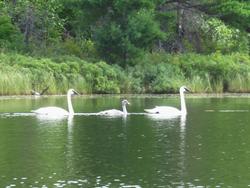
Our plan for the day was to move on up the border, perhaps as far as Ottertrack, but to do that via South Arm of Knife and Amoeber. We paddled east through the South Arm of Knife (SAK) and took the first portage to the north, which put us in a narrow bay of Knife Lake where we spotted a pair of trumpeter swans with a cygnet. As we approached the portage into Amoeber we found ourselves on the edge of this year's burn, and the portage into Amoeber was blocked for safety reasons.
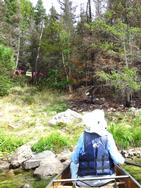
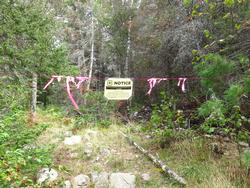
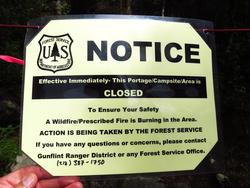
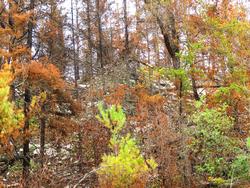
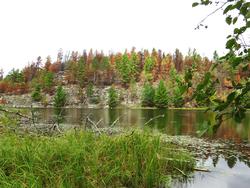
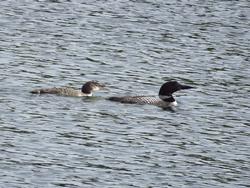
We checked the second portage into Amoeber, but again saw pretty serious burn areas, so we decided to move back into SAK, perhaps portage into Eddy, find a campsite, and study the maps more for a change of plans. Just out of the portage we saw an adult loon with a juvenile. We also saw several bald eagles today.
Also just out of the portage was a nice campsite (#1436); when we started across SAK and the full force of the wind hit us, we elected to return to that site. We set up camp even thought it was early afternoon, and studied maps for a route southeast of the burns. Dinner was shrimp with garlic pasta. We played Farkle before and after dinner, read more Patrick McManus stories, and again were asleep around 8:00pm. At 12:30 or so we awoke to sprinkles and a constant show of heat lightning, so closed the vestibule doors. The sprinkles turned into light rain that continued most of the night. The new Big Agnes passed its first rain test with flying colors.
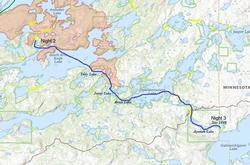
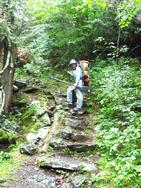
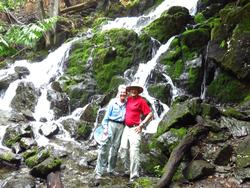
The overnight rain had stopped by 6:30am and we exited the tent to another gray morning. Breakfast was coffee and hash browns with bacon. We packed gear, loaded the canoe, and were on the water before 9:00. The gray cloud cover had descended, so we crossed the wide section of SAK in a mist (but no wind!), and our compass reading took us directly to the portage into Eddy. What a beautiful portage: nice stone steps at the start, then a climb beside a roaring waterfall. The east side of the falls had seen pretty significant burn, and it appeared that the end of the portage had been used as a fire break and backburn. We left gear at the Eddy landing and walked back down the portage for photos at the falls and at the top of the portage.
From Eddy we portaged into Jenny, where the mist turned into light rain. We donned rain gear, then stopped further down Jenny for lunch and to check our weather notes. During lunch the rain stopped, and we moved on down the chain of lakes and portages to Agamok. The last two portages, Ogishkemuncie to Mueller and Mueller to Agamok, were long and challenging with lots of climbs and drops with some serious muck thrown in for extra credit. Reaching Agamok, our destination for the day, we started looking at sites. The first two were in sad shape, and the third didn't exist, having been burned over. The last site on the lake (#1848) was close to the portage into Gabimichigami and met our needs. We set up our wet tent to dry and had hot drinks as a warm sun and blue sky broke through the mist. While looking for a good bear hang site, I found a long, slender sapling that a beaver had harvested and abandoned. Rather than throwing weighted cords over limbs, I was able to use a fork at the end of the sapling to position my hang. Dinner was a hearty white bean, kale, & turkey soup that we ate while watching an otter playing in the lake. After dinner we read more McManus and hoped the clear sky would last through the night. As we tucked into our sleeping bags, we heard a whippoorwill, a bird we hadn't heard in Canoe Country before. Later, after a 'nature call' where we were treated to a star-filled sky, Tia shared Wendell Berry's “The Peace of Wild Things”, one of many poems she has memorized.
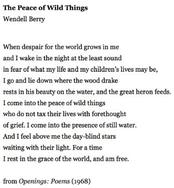
Several days after we returned home, we learned that Berry had died August 31.
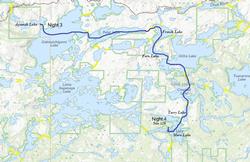
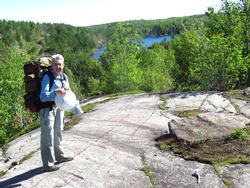
We awoke to a beautiful clear sky with slight breeze, and enjoyed a breakfast of coffee and gallo pinto with ham. The portage out of Agamok simply bypassed a stream, and there was enough water to walk the loaded canoe up the stream into Gabimichigami, a wide lake that was already showing some whitecaps. It took about 30 minutes to cross Gabimichigami, and after we portaged into Peter we had the wind to our backs. The 121 rod (about 600 meter) portage into French Lake climbed from the base of big cliffs until we were on top of them, then opened into a young birch copse and a bare rock overlook with a great view.
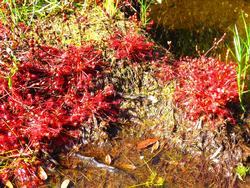
And when we entered French Lake, we found lots of pitcher plants and sundews near the portage.
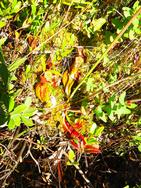
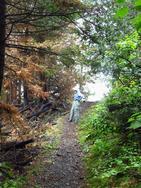
Some of today's portages could have benefited from trimming, but we suspected our proximity to fire areas disrupted regular trail maintenance schedules this year. We saw a couple grouse on today's portages, and saw a raft of mergansers on one of the smaller lakes. We mostly managed to avoid wind and waves today by traveling smaller lakes, but by the time we reached our campsite on Mora (#526) we were wasted. We haven't seen too much difference in the BWCAW and Quetico portage trails, but have been very impressed with the lack of TP litter which we attributed to BWCAW's policy of a biffy in each campsite.
The night's dinner was curried couscous with chicken, cranberries, and almonds. More Farkle, more McManus stories, then into sleeping bags.
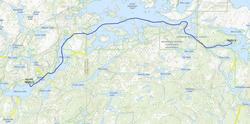
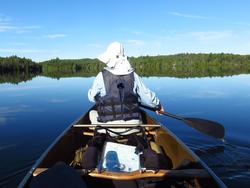
We woke to a calm beautiful day, our 54th anniversary. Mora Lake was a mirror as we had our breakfast of coffee and loaded oatmeal, and we were on the water before 8:30.
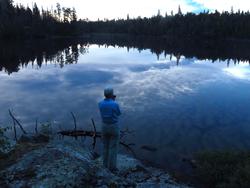
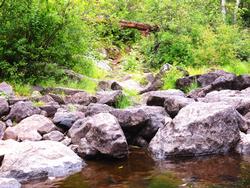
Our portage into Little Sag was a perfect start to the day's travels: both landings were nicely graveled and surrounded by an array of wildflowers. Between Mora and Little Sag the water tumbled through a rocky gorge, and the well-worn portage path above the gorge offered near-constant opportunities to appreciate the beauty of the cascading water. Tia said it's a portage worthy of a name, and suggested Glorious Gorge; she said she'd do the portage again just for the beauty.
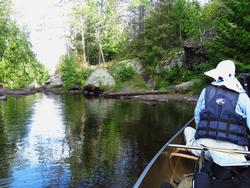
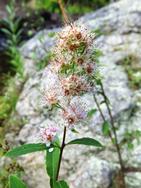
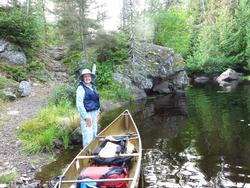
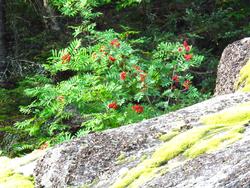
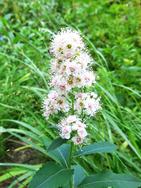
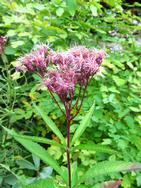
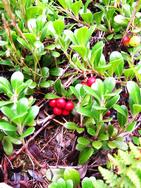
Little Saganaga is a big lake, but crossing its southern end offered lots of islands to provide wind shadow if the wind picked up. Wind was never an issue though—the day's paddling was perfect. We had to look a bit to see the portage into the no-name before Elton. At the portage end we met six people/three canoes who shared a lot of information about the route ahead of us, including rave reviews of a couple sites on Makwa, our destination lake for the night. We ate lunch on Makwa's first site, then moved on to evaluate the second and third sites. While the bald rock third site was very tempting, we elected to return to the middle site. It's better suited to our bear hang needs and the desire to clean up a bit. After sponge baths and afternoon coffees, I prepped a lime cheesecake for the dessert we'll have after our 54th anniversary dinner of shrimp chimichurri, an interesting recipe Tia found online a few weeks before our trip. Tia looked up some of the plants we saw on the Glorious Gorge portage, and we reviewed our route plans for the next few days—we don't want too many or too few miles between us and our exit. We decided we have the time and energy to drop further south, then turn back toward Ensign Lake and our Newfound/Moose Lakes exit day paddle.
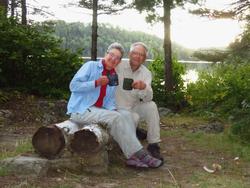
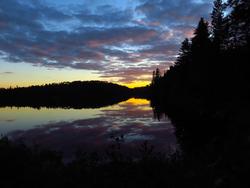
We've moved south of the burn areas, and have enjoyed seeing the big cliffs lining lakes the past couple days—we thought that might just be a Quetico thing. Dinner was the shrimp recipe mentioned above followed by cheesecake, then played Farkle and read more McManus stories. We were also entertained by a couple beaver swimming past our site and slapping their tails when they spotted us. We took an anniversary photo, then enjoyed a nice sunset before retiring to the tent.
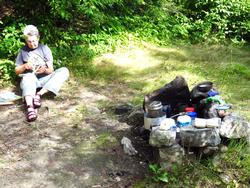
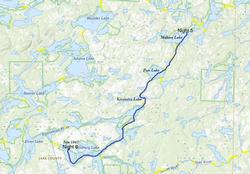
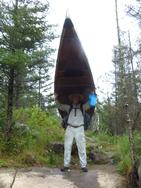
We woke to a gorgeous day, but it was chilly enough that we pulled our puffy down jackets from their pillow cases and wore them as we had our breakfast of coffee and hash browns with bacon. Heavy dew was on the tent and campsite, and the lake was shrouded with mist. We were on the water around 8:30. Today was all about portages: we did six before lunch! Most of today's portages were overgrown, but were fairly level. Heavy dew plus overgrown portages meant we looked like we had walked through a carwash by the end of each portage. At the end of the second portage, I hung a foot under a root and crashed to the ground with some 60 pounds of pack and canoe weight driving me forward; luckily I escaped with only bruises to the right forearm and right hip/knee. The portage from Panhandle to Pan started from a narrow, shallow channel. We found boot prints and a distinct footpath at the start of the portage, but it was crazy-overgrown for its entire length. At Pan Lake's end of the portage we found a nice sandy put-in and a new, recently-maintained portage coming in from our right. We had bulldozed through a portage that must have been abandoned five years ago!
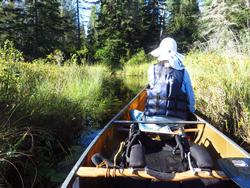
Our map showed a couple portages and a stream between Pan and Anit Lakes, but it's now a single long portage. After Anit we portaged into Kivaniva, then Kawishiwi River, where we stopped for lunch at a rocky campsite. After the lunch break, we portaged into Malberg and started evaluating campsites for the night. We stayed at the site (#1042) at the west end of Malberg, near the portage back into Kawishiwi River. It's a great site, with a sandy landing, multiple nice tent sites, plenty of trees for rain tarp and bear hang. It was only 2 PM when we stopped, but Malberg had been the day's objective and stopping early gave us time for afternoon tea/coffee, cleaning up a bit, and studying the maps.
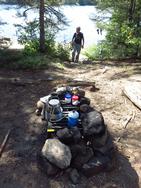
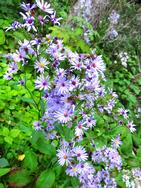
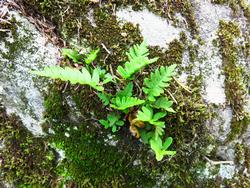
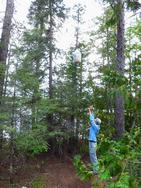
The afternoon sky stayed blue with a few puffy clouds and just a light breeze. Dinner was beef stroganoff with mushrooms, a standard for several years' trips. Solid gray cloud cover moved in while we were eating dinner, and we'd only been in our sleeping bags a few minutes when light rain began. We zipped up the vestibule doors, and the wind and rain increased, accompanied by lightning.
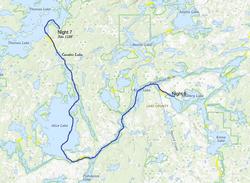
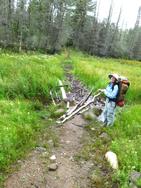
Last night's rain stopped around 11 PM and for a little while the sky cleared enough to see the moon, but then we had another session of hard rain. We awoke to gray skies and a wet camp; the lake was like glass. We had our breakfast of coffee and gallo pinto with ham, packed up wet gear, and moved on. Our first portage, Malberg Lake to Kawishiwi River, looked very inviting, then routed us through a boggy area in the middle. We stopped long enough for a couple photos, finished the portage, and launched into the long, narrow Kawishiwi River.
As we entered River Lake, we spoke briefly with three anglers who asked if we were headed for the pictographs on Fishdance Lake. Our maps didn't show a picto location, but the fishermen thought they were near the portage, so we paid close attention to cliffs near the portage to the no-name and Alice. We didn't find the pictographs and later learned that they are further down Fishdance than we traveled.
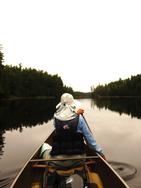
Alice Lake might be rough paddling on windy days, but our day was calm and gray. We paddled north on the main body of the lake, then stopped for lunch at a low rocky finger between two campsites. From our lunch stop we continued north in a narrow channel to the short portage into Cacabic. From Cacabic into Thomas the portage is 205 rods (just over a kilometer); we discussed stopping roughly halfway through the portage for a rest break. The portage started with nicely maintained causeway and boardwalk sections, then turned into a more typical portage with gentle climbs to dry ground followed by descents to wetter areas. The entire length of the portage had excellent footing, so we walked its full length without stopping.
On Thomas Lake we moved north to the end of a point, then looped around the point to check out the first available site in our travel direction. It was a nice site (#1186) with a sandy landing, a pretty cooking area, an easy bear hang, and a large flat tent site, so we were set for the night. We hoped to dry the tent fly, but the damp, cloudy day and the light mist didn't cooperate. We had cups of ramen to warm our bodies and spirits. Over the cooking area I put up a ridgeline for our rain fly so we could quickly erect it if weather turned into more than a mist. Dinner was Suwannee Stew, a recipe we have used on a couple river trips. While cooking dinner, a bald eagle landed just across the inlet, and later we heard a wolf howl. We've never seen a wolf on our BWCA/Q trips, and only once before heard wolves. When we mentioned the howl to our outfitter, she told us that in 2025 a wolf was photographed in front of Ely Memorial High School, whose mascot is the Timberwolves!
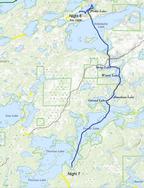
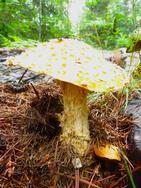
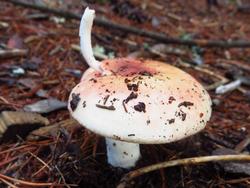
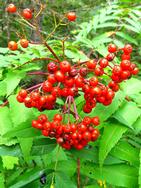
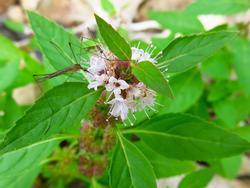
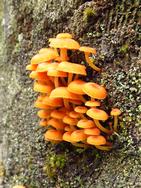
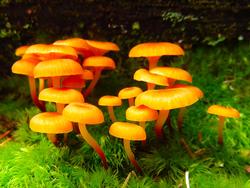
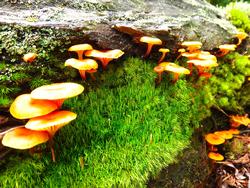
We were up at 2 AM for a nature call and could see stars, giving us hope for a clear day. When we got up around 6:30 we had light cloud cover, then started seeing patches of blue as we had our breakfast of coffee and loaded oatmeal. We left Thomas Lake and entered Fraser Lake via a narrow, pretty channel where we surprised an otter. Just into Fraser we surprised a beaver that slapped the water with its tail, then disappeared. All six of the day's portages were well-maintained, some with causeways and stone steps, and most were short. We saw lots of mushrooms and other plants along today's portages. We stopped at the first campsite on Kekekabic Lake for lunch—what a rocky site. Both pitching a tent and sleeping there would be rough, but the site gave Tia a view of a grouse and an American redstart.
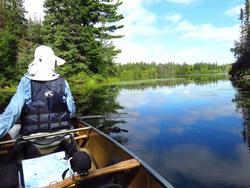
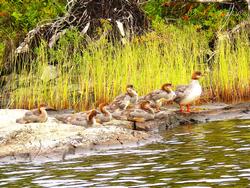
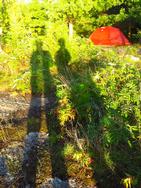
Kekekabic Lake was very calm as we crossed, and our compass reading took us directly to the portage into Pickle Lake, our day's destination. As we started inspecting campsites, however, we decided we might really be in a pickle! The site near the portage and the two sites east of the portage into Pickle had rocky tent sites and were fairly overgrown, but exploring sites let us find a group of mergansers loafing in the sun. Pickle Lake's western site (#1409) had a nice smooth rock for much of its surface and a grassy flat area for the tent. We spread out still-wet gear to dry; the mostly blue sky and gentle breeze had things drying quickly.
A dinner of curried couscous with chicken, cranberries, and almonds was followed by Farkle and more McManus stories. There was some color in the evening sky, but we couldn't really see the sunset from our site.
We were up briefly during the night under a clear sky with stars and a quarter moon reflecting in the lake. Morning brought the first clear sunrise of this trip—other mornings were either gray, misty, or our site didn't have an eastern view. Breakfast was coffee gallo pinto with ham.
The portages into Spoon and Skoota Lakes were short, and all today's lakes were calm. As we paddled toward the portage into Skoota we spotted four otters, which quickly scooted into the brush, but not before chuffing at us. In Trader Lake we saw two more trumpeter swans. The portage from Trader to Vera started with a 3' ledge which neither of us could manage with our portage loads, so we piled our gear onto the ledge, scrambled up to move gear out of the way, then passed the canoe up.
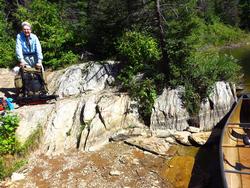
We had lunch on Vera Lake at its eastern-most campsite. The site had multiple tent pads and a tiered area around the fire grate; it would easily accommodate a group of eight or nine, and kids would enjoy climbing the rock ledges. This was the only place we had issues with flies, however. After lunch we headed toward Ensign Lake, but our National Geographic map showed two portages into Ensign from Vera. The east one looked like it was routed through a pond, and was a bit overgrown at the landing. Our McKenzie map only showed the west portage, and at the landing it was clear that it had been brushed and frequently used during the 2026 season, so we took it. It was 180 rods (900+ meter) in length, and started with a steady climb that after ten minutes or so topped out on high, bare granite domes and slabs. We felt like we were on top of the world. At the end of the portage we met two anglers headed to Vera; when they asked how we liked the long portage, Tia told them it was beautiful and one of her favorites of the trip. We asked about the other portage and they referred to it as the winter or dog sled portage. We checked a couple sites on the east end of Ensign Lake, and opted for site #1223 which was well above the lake and had a nice eastern view. We had paddled in full sun all day, and were hot and smelly as we completed camp set-up, so the next order of business was to get clean. Afterward, with late-afternoon shade and a light breeze, life was good, and we reflected on our BWCA trip versus our Quetico trips. Dinner was turkey, kale, and white bean soup and was followed by Farkle and McManus stories.
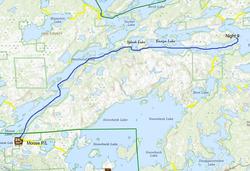
We were up around 6:00 AM, as usual. Breakfast was coffee and hash browns with bacon. The morning was back to gray skies, so we didn't have any sunrise color. We were on the water just before 8:00 AM, thinking that the light breeze might turn into real wind on Newfound and Moose later in the day. We had seen several groups of paddlers pass our site yesterday afternoon, and as we paddled the length of Ensign we noticed that many of the campsites we passed were occupied—we were very happy we stopped when and where we did yesterday. As we approached the west end of Ensign we began to hear the towboats bringing canoes and paddlers up Newfound. The portage between Ensign and Splash was a surprise, as we were off our NatGeo maps and the McKenzie didn't show it. We might have been able to walk the stream between lakes, but the portage was short and level. At the end of the stream into Splash three mergansers swimming in the rapids were alternating between eating something from the water, then plucking red osier dogwood berries from low-hanging limbs over the stream. We were quickly through Splash Lake, and portaged into Newfound, where a couple groups were unloading canoes and gear to begin their BWCAW trips. [paragraph break] Paddling Newfound and Moose Lakes was a pleasure Labor Day morning; we only had a light breeze and the towboat traffic made our return route to the Moose Lake landing very obvious, so we could ignore the maps and simply paddle. At the Moose Lake public landing we carried gear to the edge of the parking lot, retrieved the car, put on dry shoes (aah, the simple pleasure of dry feet!), and loaded gear and the canoe. Our menu planning was good this year—we just carried out a few electrolyte drink packets, a package of ramen, a dozen crackers, and 6 granola bars. Some of that disappeared on the drive back to Ely. We stopped to thank folks at Spirit of the Wilderness for their pre-trip advice and to check their sale items, then hit Dairy Queen for a chicken strip basket. Driving on through Ely we saw that the Frisky Otter was serving lunch and considered it for our after-trip dinner. We were able to check into our Canoe On Inn room early and were soon clean and ready for a walk through town. Each year we try to find a better (and lighter) plant guide than the 1978 edition of 'Plants of the Canoe Country' we bought in 1979, but so far it can't be beat! I drooled over a couple canoes, but we'll stick with our Northwind 17 for a few more trips.
We headed to the Frisky Otter for dinner, only to discover that they closed after lunch. The line at The Boathouse was out the door, so we shared a pizza from Domino's and retired early.
We started Tuesday with coffee and cold pizza, then cranked up the Forester and headed south. The 1250+ mile drive was again split into two days' travel, during which we critiqued the trip, gear, food, etc.
Both Quetico and BWCAW provide the “unplugged” experience that allows us to forget about the daily grind and simply focus on our paddling trip. No politics, no news, no electronics—just live in the moment. While Quetico may have fewer people, once we got a couple portages away from main BWCAW lakes we saw only a few people each day. We've collected lots of maps, pictograph info, route ideas, etc, for Quetico, and we need to put similar energy into BWCAW tripping.
After each trip we review each gear item to see how it might be improved or if it needs to be replaced. No major ideas this year, except we keep reading about lightweight 4” thick insulated pads. We have nice 3” pads, but a couple campsites this year had bumps we could feel in some side-sleeping positions. Canoe, cooking gear, packs, almost everything has been updated through the years so we're pretty well self-outfitted. [paragraph break] We need to start collecting BWCAW maps and route ideas, perhaps play with other entry options and consider 'blended' trips where part of our travel is in BWCAW and part is in Quetico.