



BWCA Entry Point, Route, and Trip Report Blog
May 20 2026
Entry Point 1 - Trout Lake

Number of Permits per Day: 12
Elevation: 1381 feet
Latitude: 47.9144
Longitude: -92.3220
Trout Lake - 1
A Grand Misadventure
Entry Date:
May 13, 2026
Entry Point:
Trout Lake
Exit Point:
()
Number of Days:
2
Group Size:
2
The trip had every makings of one of my most memorable trips - a physical challenge that encountered the grand scope of the Boundary Waters and fulfilled a plethora of personal adventure goals. I left the trip with many of those things, but with something else too: a hard-earned lesson with newfound humility. It’s uncomfortable to share stories when you make a mistake, especially when that mistake has an impact on other people and when it feels like something that should have been so easily avoided. This story is one of those - a tale of how an incredible adventure was derailed by a single mistake and a handful of happenstances. That simple mistake could happen to anyone on a backcountry trip, and the lessons we learned late Thursday night form a vivid wilderness curriculum neither one of us who experienced it will soon forget.
The idea of this trip was first conceived after two friends and I set out to do the Voyageur Challenge. It was an incredible, unforgettable trip, marking the beginning of a multi-year dream to attempt a similar adventure from a very different angle. The Voyageur Challenge follows the border route and is defined by long paddles with infrequent and short portages. This new route would be something else. I envisioned an interior passage: a “border route challenge” that never touches the border. Instead, we would cross the Boundary Waters along the numerous interior lakes with short paddles and frequent portaging. Along the way, I also hoped to finally conclude a personal goal of mine to utilize every BWCAW canoe entry point (either by entry or exit). I had two remaining (not counting alternates), and this would be a great chance to wrap those up.
The first logistical hurdle came with deciding when and with whom. With a young baby at home and many of my friends living in similar life stages, finding time was challenging. My wife gave me the go-ahead for a four-day trip, which isn’t a lot of time for 160 miles (including 25 miles of portaging), but I would gladly take it. My list of tripping partners dwindled quickly: “having a baby,” “getting married”, “just had a baby,” or “no time off” were frequent responses. Three of us finally decided on a date, and we began planning. With a couple of weeks to the trip, one of the guys had to back out for family reasons. With two of us left, we loaded a two-seat Minnesota 3 and headed for Lake Vermilion and our grand adventure.
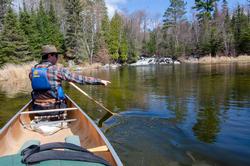
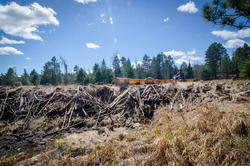
We started on Lake Vermillion at 10:00 on Wednesday morning. The weather was clear and calm, and we made fantastic time to Trout Lake. We turned east on Trout to take our first 200ish rod portage into Pine. It would be a portage-heavy day. From Pine, we went north on the river and portaged into Chad (a bit of a tricky portage to be sure). Much of the rest of the afternoon would be spent taking portages of similar distance, difficulty, and deferred clearing. From Chad, we headed into Buck, Western, Glenmore, Schlamn, and on towards Lunetta, where our first misadventure occurred. We didn’t see the final portage and ended up plowing ahead through the floating marsh for an exhausting trudge into Lunetta Lake. From there, I was back on a familiar route through Little Crab, Crab, and onto the mile-long exit portage. The beavers have remodeled since my last visit, with the former “wet spot” now requiring a paddle across. The sun was low in the sky as we approached Burntside Lake. We gorged ourselves on food and water and headed for one of our longest paddle stretches of the trip.
As we headed east on Burntside, I had an idea of where I wanted to get before the sunlight was gone completely. Burntside can be a tricky lake to navigate if you don’t keep track of the islands. We both added layers somewhere close to Lost Girl Island as the sun had departed and the night grew cold. On our way further east, the loons began calling, and I noticed one particularly close. Not thinking anything of it, we kept paddling in the now pitch-black when my paddle struck something underwater that felt like a log. That “log” surfaced with a splash near the yoke before diving again, only to resurface with a loud thud along the stern rock guard. The poor unsuspecting loon had been struck by my paddle, only to surface, see our canoe, dive, and strike its head on the back end! It was not the least bit amused by the visit!
When we finally reached land at the Little Long Portage, I was shivering uncontrollably. I added layers and began moving with purpose to try to get warm, followed by an hour nap before continuing on. We portaged into Little Long and up the snowmobile trail into Shagwa. The paddle down Shagwa seemed to drag on as the twinkling lights of Ely drifted past. I neglected to remember the swift water going into the Shagwa River, which, thankfully, we passed without incident as numerous running suckers splashed the surface. At the culverts, we pulled out to portage as I knew, from experience, that the rapid further down are choked with log jams and boulders.
It was a long, dark, multi-mile road portage to get to the town of Winton and the small dock stretching out into Fall Lake. By the time we arrived, the first rays of morning were starting to appear beneath the slightest sliver of a moon. We both paddled with some degree of delerium towards the rushing sound of Kawishiwi Falls. Once at the bottom of the falls, we proceeded with some caution to the portage landing and stumbled our way up to the reservoir above the dam. We lay down for a brief nap there, only to be awoken by an alarm at the power plant. Sigh…. forward ever forward I suppose.
Garden Lake and Farm Lake passed quickly, and we soon re-entered the wilderness to start paddling the Kawishiwi. We pulled to the side on a rocky point and proceeded to get our first real sleep of the trip for three hours. When we awoke, the weather had changed entirely. The clear, calm morning was replaced by a windy, hazy midday.
The rest of the day would be spent heading east on the Kawishiwi. We paddled up some rapids, portaged around others, and generally made good progress. On one portage, we made it across and loaded our canoe. We were ready to push off when we heard the unmistakable sound of a canoe overturning, with the unsuspecting occupants suddenly drenched in the early spring rush. We brought our canoe back across and helped where we could by picking up one of the paddlers on the opposing shore. They offered us some bourbon, but that didn’t seem a gift that two nearly-unslept paddlers with progress to make should accept! We finally reached the east end of the river and began heading south toward Lake One. The first portage had high flow around it, but we crossed easily enough. I tucked my Pelican case under the yoke instead of by my feet, as I usually would do, since the next portage was close by.
As we paddled towards the next portage, I had vague recollections of it being tucked behind a rapid set. It's really a poorly placed trail that forces one to reroute or take a risk. We approached with some caution to see if we could work around the rapids, which were running high and strong this time of the year. A back eddy began to shift our stern, slowly at first. Suddenly, with the strength and ferocity of a snake bite, a standing wave grabbed our bow, and we began to roll to starboard. We scooped some water, but recovered it briefly. The next standing wave drove us to the rock face, where we stuck on the front right side of the bow. It was over in an instant. I remember going feet first into the icy tumult. Both of us grabbed onto the rock instinctively, with the current fighting to pull us downstream. We both let go and drifted a little further. I quickly realized that I couldn't make it back to shore while holding my paddle, so I discarded it for a stronger swim. My paddling companion thought of retrieving gear, and then thought better of it. The rapids’ icy claws were digging in, and with another stronger set downstream, it was best to save ourselves and find the gear later.
The banks are rocky and steep in this stretch of water, and we scurried out with the desperation of a half-drowned rat. When we found each other on the shore, we came to the sudden and shared realization that all of our gear was on a quick course to the larger rapids downstream. Each of us ran to catch up along the shore, one to the top and one to the bottom, to see what would become of our things. I was positioned near the top and watched the gear pause for a moment above the rushing water. One by one, things began to tumble down the next set. The pack went first; the canoe was not far behind it. I had yet to see my Pelican case surface, which panicked me. It was an item that I've made a long commitment to always keep between my feet. It contained my DSLR camera that has been with me for a decade of adventures. It had my wallet, which I never take on trail. It had my phone with all those precious baby photos on it to remind me of the home I had to make it back to. And, perhaps most unfortunate in this moment, it has my Spot Gen, something I knew to keep on my person, but the bulky inconvenience of it led me to put it away sometime in the many previous miles. Both the pack and the canoe hung up on the far shore mid-rapids, unharmed for now, but out of reach across the water.
We reconvened at the top of the hill to discuss our options. All of our gear was gone, but my friend had fortuitously kept his phone in his lifejacket as well as a Bic lighter that was well and truly flooded. The freezing cold began to sink in as the adrenaline waned; it was 5:30 PM. No group was going to just happen by at this hour. It was May; we couldn't walk down to the flat water and just swim across and hike back to a gear. Too many groups have gotten in more trouble when they “swim for it.” The walk out to Kawishiwi Lodge would take all night and then some. Even if we had been a group of two canoes instead of one, we could have retrieved the canoe, and no one would have been the wiser. With our options for self-rescue exhausted, we decided that our first time flipping a canoe should also be our first time calling for help.
We tried calling 911 first, but the call didn't connect. As we checked on the gear again, a miraculous text came through from a friend of ours: a guy we had both known from guiding days. (He has been on many of the trips I have written about before on this forum.) Through shivering hands, we tried explaining our situation over text. With that, he got to work coordinating with friends and family in Ely as well as the rescue squad. He put us in touch with a text app that allows us to talk with the sheriff's department, who walked through our situation and the options to get us out.
For me, this was an odd moment of reflection on all the stories I've heard of emergency situations, the mistakes made to get into them, and the good and bad choices that led to getting out. I thought about how I never imagined that it would be me. Perhaps that's pride or ignorance. Wilderness has a way of quickly correcting both, and today, I was the pupil, full of pride after 56 miles traveled in 30 hours. Now, I was stranded 1 mile from the Lake One public landing of all things! At least the rescue should be quick. As stress subsided and it became clear that we would be getting out that night, we shared a chuckle that somehow both of us managed to keep our hats during our ride in the swift water. We communicated back-and-forth with the sheriff and managed to get the lighter to work eventually. We got a small fire going once we were assured that the rescue plan was in progress. As we sat by that fire for hours, we shared a strange, juxtaposed peaceful moment, the quietest of the trip in many ways, as we talked about what happened, why, and how. We weren't officially on our way out until 11:40 that night, and I arrived home to the justifiably worried wife sometime after midnight with a little more than the clothes on my back and my bruised pride.
The next day, we managed to head back in to retrieve gear. We found the canoe right where we last saw it, with another group trying to extract it. I halted their work in a mix of hope and despair in case my pelican case happened to still be trapped underneath, fearing that their attempt to free the canoe could send whatever was inside it down the rapids set. To my absolute relief, I found my case inside, along with both map sets and my paddling companion’s water bottle. The pack was harder to get to 75 feet off the portage, and with a significant weight gain. After a long search, we did find my water bottle, but neither paddle showed up.
As I’ve thought about this story for most of a week now, I’m still torn about how I share it. In some ways, it’s a bit of a point of embarrassment. So many people have heard about it, and once search and rescue is involved, they rush to conclusions and judgments. In some ways, it’s a point of sadness. When I walked into church on Sunday, everyone seemed to know. I've heard that some of them had stayed up all night with worry. Another had packed up from his daughter’s sporting event, ready to come pick us up, when he heard other plans were in motion. Of course, I'm grateful for the community, but the competent, capable former guide in me aches that I caused so much worry, and I'm also embarrassed that such a story is mine. I had taken calculated risks before and always came away mostly unscathed. I've definitely been in sketchier situations and never had a need to be rescued. It felt like it was a huge deal when, in actuality, no one was hurt; we were okay!
If any number of circumstances had been different, we would have gotten ourselves out without impacting anybody. So I've teetered between sharing this unbelievable story and keeping it to myself. It didn't help that when my paddling companion shared our lost and found items on Facebook, he got torn to shreds by people chastising our choices, wondering how we could be so stupid, and even one joking about how we didn't “leave no trace.” There’s been plenty of uninformed, prideful people armchair quarterbacking this thing. In some ways, that stung. I know their opinions don’t matter, specifically, the opinions from the people who don't know us, our experience, or how deeply we care about this place. In spite of that, I have chosen to share this story because if it can happen to me, I'm sure it can happen to anyone. It didn't happen because of a lack of skill; perhaps it happened because of a lack of caution, something that could collapse on any long wilderness day. Perhaps things would have been different in other days or other circumstances. In lower water, perhaps we wouldn't have flipped. In warmer water, perhaps we would've stayed with our gear. If it were earlier in the day, perhaps we would've waited for another group. There were so many pieces in motion to make this circumstance what it was, and that's the lesson. Eventually, someday, all the pieces will align in just the wrong way between the choices we make, and the wilderness as we make them in. This re-teaches us a lesson learned many times before through other people's stories and experiences, but never in our own, so that the next time we proceed with a little more caution and a little more respect for wild places that are still wild. Wilderness forever holds the power to humble the proud and the capable. Our thanks go out to the folks who set aside their evenings to get us out. May our tale help you someday avoid the same, and thanks for reading.