
BWCA Entry Point, Route, and Trip Report Blog
November 28 2026
Entry Point 55 - Saganaga Lake

Saganaga Lake entry point allows overnight paddle or motor (25 HP max). This entry point is supported by Gunflint Ranger Station near the city of Grand Marais, MN. The distance from ranger station to entry point is 55 miles. No motors (use or possession) west of American Point. Access to Canada (the Crown land and Quetico Park). Large lake with many campsites and easy access. This area was affected by blowdown in 1999.
Number of Permits per Day: 15
Elevation: 1184 feet
Latitude: 48.1716
Longitude: -90.8868
Saganaga Lake - 55
The First One
by freeboard
Trip Report
Entry Date:
August 15, 1982
Entry Point:
Saganaga Lake
Exit Point:
Seagull Lake (54)
Number of Days:
5
Group Size:
10
Trip Introduction:
There are a lot of great “how it all started” trip reports here. I have enjoyed reading all of them and thought it would be fun to add mine. This trip happened in August of 1982. Before I get started, I figure I’ll mention that this recollection is completely from memory. To my knowledge, nobody brought a camera along and I’ve long since fallen out of contact with anyone that was on the trip with me (and I don’t know how much of the trip they’d remember anyway). The only physical memento of the trip is the McKenzie BWCA map that I bought after the trip that our guide marked out the route we took. So, this trip report is based entirely on my recollections from over 40 years ago and as such, there is no guarantee that my descriptions of the trip here are accurate.
So how did I get onto this trip in the first place? Well, the youth group at the church down the street from our house planned a canoe trip out of Wilderness Canoe Base on Seagull Lake, and my parents thought it would be a great idea if I joined them. I was 14 years old and had no idea what the BWCA was all about, but the trip sounded fun. My family was not into camping, so we had to make a couple of special purchases for the trip. First, one of those cheap rain ponchos that come in a plastic pouch. And second, we heard the bugs could be otherworldly, so we bought a little container of Muskol to ward off the swarms of bugs we’d encounter. Those two things, a fishing pole with a small amount of tackle, a sleeping bag and a few changes of clothes would’ve been all I brought with me on the trip. Everything else was supplied by Wilderness Canoe Base.
Part 1 of 5
With that, 15 of us kids, the church youth group director and a chaperone loaded into a bus and off we went to the end of the Gunflint Trail. I don’t recall much about the trip up to Seagull, but one thing I do recall was that one kid (we’ll call him “J”) took an instant dislike to me and started in with me on the ride up. Although I was headed into 9th grade in a few weeks, I was behind on the adolescent development curve – both physically (I was under 5 feet tall and 100 pounds) and maturity-wise, so I felt like I had no choice but to just take it. I knew that we were going to split into two separate groups once up there, but it was my bad luck that J was going to be in my group. So, the trip wasn’t getting off on a good start, at least for me. [paragraph break] The first afternoon was orientation at Wilderness. One of the things that happened then was that we were told what our planned route was going to be. Our group’s route was to head north onto Saganaga, and then loop south and east to arrive back on Seagull a few days later. We’d camp on Sag, Jasper, Peter and the last night on Seagull. Not a huge loop, but pretty ambitious for a group of teenagers on their first trip. Especially considering that last portage to back onto Seagull: the 515-rodder now known as the Paulson Portage. (note: I know that this portage is generally marked as being “only” 409 rods, but I know we were told it was over 500 rods, so that is what I am going with here). At this point in the trip, we had no idea what a “rod” was, so it didn’t yet sink in about what was in store for us. [paragraph break] The only other thing I remember about orientation was that they had all of us kids go out in canoes in pairs and deliberately swamp the canoe. And if you could flip the canoe back upright and get back into it, your reward was that you didn’t have to wear your life jacket at all for the whole trip -- you could keep it under your seat while canoeing. Unbelieveable thinking about that now. My partner (“M”) and I were able to pass the test. In fact, everyone in our group passed the test and so we never wore our life jackets at all on the trip. Except for J – he failed the test and had to wear his life jacket whenever he was in the canoe. I was secretly pleased about that.
Part 2 of 5
The next day was our “go” day. Off we went from Wilderness Canoe Base onto Seagull Lake, around the corner to our first portage: the short 35 rods to the Sea Gull River. You may know the portage I’m talking about – the one that cuts through the Trails End campsite. Our first portage was an unmitigated disaster. The boys in the group – me included – attempted to portage canoes for the first time. Big aluminum canoes that seated three. The boys certainly couldn’t hoist those canoes onto their shoulders by themselves, so we helped each other. Once it was my turn and the canoe was on my shoulders, I immediately buckled underneath it right into the parking lot of the campsite. And it didn’t go much better for the other kids in the group: none of the kids had the strength to handle those big aluminum canoes. It turned out that our guide and chaperone had to carry the four canoes over each portage while the kids handled all of the packs. We limped over that first portage and then launched onto the Sea Gull River, completely deflated about our canoe tripping abilities. Now we absolutely knew what a “rod” was. The knowledge that there were numerous much longer portages ahead of us--and especially the Paulson monster portage--weighed heavily on our minds. [paragraph break] But that was in the future – since we were staying on Sag that night, we were already done portaging for the day. We made quick work of the Sea Gull River – I recall saying “hello” to people sitting out on cabin decks in the area before we entered the BWCA. I didn’t find out until years later that we also canoed right over the spot where only three years earlier the state record walleye (35¾” and 17½ pounds!) was landed. The day was beautiful and breezy – once we got out onto Sag, we caught a nice quartering tailwind. I remember that the waves seemed fairly large, but don’t recall anyone being overly concerned with capsizing. Probably because those big aluminum canoes we had so much trouble with on the portage were very stable. We didn’t have a huge day – by the look of my map, we stayed on Campsite 390 on the far eastern end of Munker Island. [paragraph break] On this first campsite, our guide showed us how to set up camp. There were two large tents that needed to be set up – one for the six boys and the other for the two girls, our guide and our chaperone (both female). And food (all freeze dried for this trip) needed to be prepared. All new to us, so it was a bit of a production on that first day. Later on, after dinner, I recall heading out away from camp to look out at massive Sag. And all of a sudden, the weight of the day caught up to me. Here I was, out in a real wilderness for the first time, with a kid in my group who wouldn’t stop picking on me, getting crushed on the first portage and I just lost it. I started crying, wondering what the heck I was doing out here and how much I would have given just to be back home. After a while, I got ahold of myself and headed back to camp. Fortunately, nobody from camp was within earshot, so nobody else was any the wiser. [paragraph break] ~Sea Gull Lake, Saganaga Lake
Part 3 of 5
The next day, we went from our island campsite on Sag down to Jasper Lake. We camped on the north shore of Jasper, but I am not sure which campsite. I do remember, even to an immature 14- year-old, how scenic and gorgeous this little corner of the BWCA was. I seem to recall a lot of stately red pines in this area. At that time, we were still almost 25 years out from when the Cavity Lake Fire devastated this area. [paragraph break] On Day Three we headed from Jasper to Peter. I remember being fascinated with all of the cool lake names. We called Ogish “Ogish-Chuck Muncie” in honor of the great San Diego Charger running back. I don’t recall any specifics about this day, but I do recall that after getting about ten more portages under our belt since the Trails End disaster a couple of days prior, we started to hit our stride. Everyone figured out their specific task from landing to portage to launch and we were feeling pretty good about ourselves. But not so good that we stopped talking about (and dreading) the Paulson portage that loomed. [paragraph break] ~Saganaga Lake, Red Rock Lake, Alpine Lake, Jasper Lake~Saganaga Lake, Red Rock Lake, Alpine Lake, Jasper Lake, Kingfisher Lake, Ogishkemuncie Lake, Mueller Lake, Agamok Lake, Gabimichigami Lake, Peter Lake
Part 4 of 5
Day Four. The longest day. We left Peter and tackled the ten or so portages east out of Peter. And then in the afternoon we finally arrived at the Paulson portage. The one that had hung over our heads for the past three days. Our guide and chaperone had concluded that there was no way that they were going to be able carry all four canoes over the portage between the two of them. We had to come up with another way. Since we already knew that none of the kids could carry a canoe by themself, we realized the only way we could accomplish this carry was to “two-man” the canoe with one kid carrying the front of the canoe and one carrying the stern. Those lifejackets that we didn’t have to wear at all during the trip finally came in handy by giving us some padding on our shoulders while we were carrying the canoes without using the yokes. The portage was as bad and as tough as we feared. It went on and on. And on. Up and down. I’m sure it took us over well over 3 hours because we’d have to take breaks along the way. There was no way a scrawny teenager like me could carry that canoe non-stop. And this was so long ago that there were still canoe rests installed on the sides of trees along the longer portages. I'm sure we stopped at every single one of them. It was without a doubt the toughest physical act I had done at that point in my young life. And then we made it. What an accomplishment for this rag-tag group of kids who, just days earlier could barely handle a small portage across a parking lot. We were just kids when we started the trip, but now we felt bigger than that. We discovered that we were capable of a lot more than we originally thought. Which we didn’t know at the time, but was of course one of the reasons for going on the trip in the first place. And the group grew closer together. I didn’t become friends with “J” or anything like that, but over the trip, he stopped picking on me and a détente of sorts was achieved. [paragraph break] We set up one last camp on Seagull that night. I don’t recall exactly where. The one thing I vividly remember about that second-to-last paddle on Seagull was that we saw moose – a cow and her calf swam from one island to another. I have never seen a single moose on a BWCA trip since then. [paragraph break] ~French Lake, Gillis Lake, Bat Lake, Green Lake, Flying Lake, Bingshick Lake, Glee Lake, Elusion Lake, Glossy Lake, Japanese Lake, Seagull Lake
Part 5 of 5
After that big day, the next day was anticlimactic. I don’t remember anything about the rest of the trip, not the paddle back to Wilderness Base nor our bus ride home. [paragraph break] Looking back, this trip was a great way for me to start a lifelong love of the BWCA. The weather was absolutely perfect: not too hot (except for maybe that afternoon on the Paulson portage) and no rain and no bugs: the poncho and the Muskol that my parents got me specifically for this trip both went unused. We all know how rare that is to encounter neither rain nor bugs on a trip. 1982 must’ve been a dry summer. [paragraph break] So that’s what I can recall from over 40 years ago of a trip that launched a couple dozen more trips. I’m glad the neighborhood church planned this trip and my folks encouraged me to go with. There’s no telling how I would’ve been introduced to the BWCA (if at all), had this trip not happened. [paragraph break] 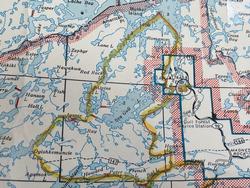
discuss this trip report (1 comments) - last post on November 28, 2026